Wednesday, 9 December 2015

Saturday, 14 November 2015

Bilbo Tour

BILBO

It is the largest municipality of the Basque Country and the tenth largest in Spain it one of the most populous metropolitan areas in northern Spain.
Bilbao is situated in the north-central part of Spain Its main urban core is surrounded by two small mountain ranges with an average elevation
Bilbao was a commercial hub of the Basque Country that enjoyed significant importance in Green Spain.
Ayuntamiento de Bilbo
The building was built in 1892 by Joaquín Rucoba, on the former site of a convent in the district of Uribarri. It was built in Baroque style. One of the highlights of the building is the Arab Hall, a richly decorated hall in the Neo-Mudéjar style that resembles the decorations found in the Alhambra of Granada. The hall is used for official receptions and weddings.
Before 1890, the city's council was located in a building inside the Old Town.
ARRIAGA
The Teatro Arriaga is an opera house. It was built in Neo-baroque style by architect Joaquín Rucoba in 1890, (the same architect that built the city hall). It is named after Juan Crisóstomo de Arriaga, known in his time as the "Spanish Mozart".
The theater was rebuilt in 1985 after severe flooding destroyed it in August 1983.
Biscay Foral Delegation Palace
It was built between 1890 and 1900 by architect Luis Aladren, in the Gran Vía de Don Diego López de Haro avenue. It is important because is a branch of government of Biscay.


CATHEDRAL
Santiago Cathedral is a Catholic Cathedral in the city of Bilbao. The temple was originally built during the 14th-15th centuries as Bilbao's main parish church, and was only declared cathedral in 1950 when the Roman Catholic Diocese of Bilbao was officially created. Its origins probably date to well before the foundation of the city in 1300, when Bilbao was little more than a small enclave of fishermen.
BILBO
Architecturally, the present building is a mixture of styles: from the 15th century Gothic of the cloister and the main vault, where of special interest are the cloister and the beautiful portal that gives access Correo street (Puerta del Angel), to the ostentatious Gothic Revival façade and spire.
Parque de los patos
Doña Casilda Iturrizar park is a public park . It is named this way after Casilda Iturrízar, donated the terrains.
It was the only lung of the city until a few years ago. It is an English-style garden created more than 100 years ago, in which the main highlights are the perfectly preserved examples of many centenary tree species.
Attractions
Within the park there is a duck pond with various species of waterfowl, the park is nicknamed Parque de los Patos (Duck's park) by the locals because of this pond. There is also a cybernetic fountain that offers annually sound and light shows during the holidays, surrounded by a large space where concerts are held and a pergola.

SAN MAMES
San Mamés is the name of Athletic Bilbao’s football stadium. The stadium replaced the "old" San Mamés as the home of Athletic Bilbao.
The first san mames was opened in 1913 and 100 years later in 2013 was inaugurated the new san mames. The old san mames was the oldest stadium in Spain before the delosion
The new stadium have capacity to 53,000and it was built next to the old san mames.The construction began in 2010 and 3 years later Three quarts was compete, when de `liga´ finished the athletic demolished the old san mames and they started paying in the new when it wasn't finished yet.


Euskalduna Jauregia
It was designed by architects Federico Soriano and Dolores Palacios and work started in 1994. It was opened in February 1999 and contains a variety of spaces, functioning as a conference center, opera house and concert hall. In 2003 it was declared by the International Congress Palace Association as the world's best congress center.

It is used as an Auditorium (for opera productions by the ABAO (The Bilbao Association of Friends of Opera) and the Bilbao Symphony Orchestra. It has the largest stage of any theatre in Europe), as a commercial gallery, a restaurant, an Exhibition Hall, a commercial gallery.


Mungia Tour

MUNGI TOUR

  • Lauaxeta:
It is the school where we study. This building has the name of a famous poet who was killed in the civil war.

  • “E”-> Euskararen ikurra:
This monument is in honour to the Basque language, Euskera. It changes its position, it is always moving with the wind.

  • Torrebillela:
Torrebillela is a castle in Mungia. It is one of the oldest buildings in the town and it was built in the 14th century. Nowadays, it is a public library and inside it, it has a small cinema too.

  • San Pedro Church:
It was built in the 12th century. Nowadays, the front of the church is the only part of the church that hasn't changed.

  • Andra Mari Church:
It is the oldest church in the town. It was built in the 14th century. Nowadays, it has been refurbished and it is used for important events.

  • Plaza “Alkartasuna”:
This fountain was built in 1983 and it is situated in the middle of Mungia. Next to it there is a big “M” which presents Mungia´s first letter. There are two squares: “Foruen Enparantza” and “Matxin Enparantza”. The market is held in this place.

  • Agirre Jauregia:
This palace is a historical building from the 18th century. Inside it, there are some Town-Hall offices and it is a music school nowadays.

  • Town Hall:
It is the town council of Mungia. It was made in 1900. This building has Basque characteristics and it also has the pelota court inside.

  • Fronton (pelota court):
It is a very big place with lots of seats where you can see pelota matches. When the town's festivals are celebrated, some famous pelota players come and play here. It was refurbished some years ago.

  • Olalde:
In this building a lot of different kinds of culture activities are held, like dances and concerts. There is a café too. Outside the building there is a place where you can play some Basque sports.

  • Railway station: 
The old train went from Mungia to Erandio, another town in Biscay. We only have this wall to remember the station. Nowadays it is also used to put rides on festivities.

  • Olentzeroren etxea: 
Landetxo’s family built in the 1510 the first farm of Basque Country, so it's the oldest farm house of Bizkaia, After that, they lived there more or less three centuries. After four centuries of that occurred, in the 1999, Mungia’s town hall, decided to broke down the building. Finally, they built again the house and nowadays, it is cultural center of the mythology of Basque Country which tell stories and legends of the Basque mythological characters.

  • Idi-probak:

They are a typical basque sports. They are part of Basque tradition and they are still famous. They consist in a veeeeeery big cow carrying a huuuuuuuuuuge, enormoussssssssssssssssss and bigggggggggggggggggggggg stone. This “floor” makes them it easier to carry it. In front of here we can see a typical bar of the Basque Country.


Tuesday, 21 October 2014

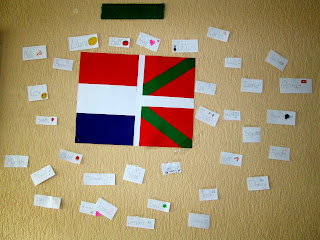
MINI DICTIONARY


ENGLISH

SPANISH

BASQUE

DUTCH
hello
Hola
Kaixo / Apa
hallo
good morning
Buenos días
Egun on
Goedemorgen
good afternoon
Buenas tardes
Arratsaldeon
Goedemiddag
good evening
Buenas noches
Gabon
Goedenavond
good night
Buenas noches
Gabon
Goedenacht
goodbye
Adios
Agur
Dag
How’s it going?
¿Que tal?
Zelan?
Hoe gaat het?


yes
Bai
Ja
no
No
Ez
Nee
I don’t know
No lo se
Ez dakit
Ik weet het niet
maybe
Tal vez
Agian
Misschien
please
Por favor
Mesedez
Alsjeblieft
thank you
Gracias
Eskerrik asko
Dank je
sorry
Perdon
Barkatu
Sorry
big / small
Grande/Pequeño
Handia/Txikia
Groot / Klein
good / bad
Bueno/Malo
Ona/Txarra
Goed / slecht
a lot / little
Mucho/Poco
Asko/Gutxi
Veel / weinig


My name is …
Me llamo...
Nire izena ... da.
Ik heet...
What’s your name?
¿Como te llamas?
Zein da zure izena?
Hoe heet jij?
Where are you from?
¿De donde eres?
Nongoa zara?
Waar kom je vandaan?
Where is the…?
¿Donde esta...?
Non dago ...?
Waar is de...?
How much is this?
¿Cuanto cuesta esto?
Zenbat balio  du honek?
Hoeveel kost dit?


I don’t understand
No entiendo.
Ez dut ulertzen.
Ik begrijp het niet.
Can you repeat?
¿Puedes repetirlo?
Errepikatu ahal duzu?
Kan je herhalen?
Do you speak English?
¿Hablas Inglés?
Ingelesez hitz egiten   dakizu?
Spreek je engels?


I like this.
Me gusta esto.
Hau gustatzen zait.
Dit vind ik leuk
I don’t like this.
No me gusta esto.
Ez zait hau gustatzen.
Dit vind ik niet leuk.
It is really tasty.
Esta muy bueno.
Oso goxoa dago.
Het is erg lekker.
What is this?
¿Que es esto?
Zer da hau?
Wat is dit?
I am hungry.
Tengo hambre.
Goxe naiz.
Ik heb honger.
I don’t feel well.
No me siento bien.
Ez naiz ondo sentitzen.
Ik voel me niet lekker.


water
Agua
Ura
water
bread
Pan
Ogia
brood
milk
Leche
Esnea
melk
coffee
Café
Kafea
koffie
tea
Tea
thee
cocoa
Cacao
Kakaoa
cacao
butter
Mantequilla
Gurina
boter
fruit
Fruta
Fruta
fruit
sugar
Azúcar
Azukrea
suiker
salt
Sal
Gatza
zout
potatoes
Patatas
Patatak
aardappels


home
Casa
Etxea
huis
High school
Instituto
Institutoa
middelbare school
school
Colegio
Eskola
school
bus stop
Parada de autobús
Autobus geltokia
bushalte
shop
Tienda
Denda
winkel
chemist’s
Farmacia
Farmazia
apotheek
baker’s
panadería
Okindegia
bakker
bank
Banco
Bankua
bank
doctor’s
Médico
Medikua
docter
supermarket
Supermercado
Supermerkatua
supermarkt


one
uno
bat
één 
two
dos
bi
twee
three
tres
hiru
drie
four
cuatro
lau
vier
five
cinco
bost
vijf
six
seis
sei
zes
seven
siete
zazpi
zeven
eight
ocho
zortzi
acht
nine
nueve
bederatzi
negen
ten
diez
hamar
tien
twenty
veinte
hogei
twintig
thirty
treinta
Hogeita Hamar
dertig
forty
Cuarenta
Berrogei
veertig
fifty
Cincuenta
Berrogeita hamar
vijftig
sixty
Sesenta
Hirurogei
zestig
seventy
Setenta
Hirurogeita Hamar
zeventig
eighty
Ochenta
Laurogei
tachting
ninety
Noventa
Laurogeita hamar
negentig
a hundred
Cien
Ehun
honderd
a thousand
Mil
Mila
duizend